What Can You Do for a Degenerative Disc
Concrete Health
What is Degenerative Disc Affliction and What Can Yous do Nearly it?
February 19, 2022
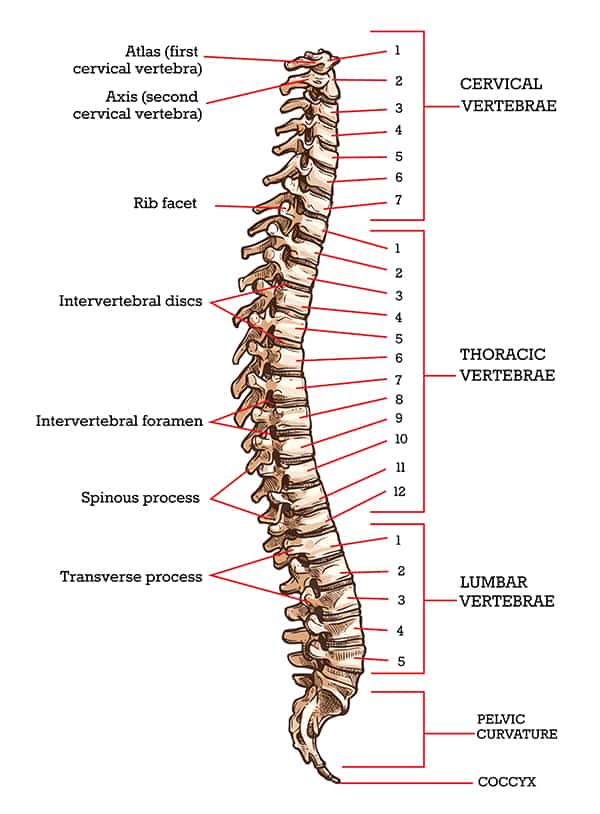
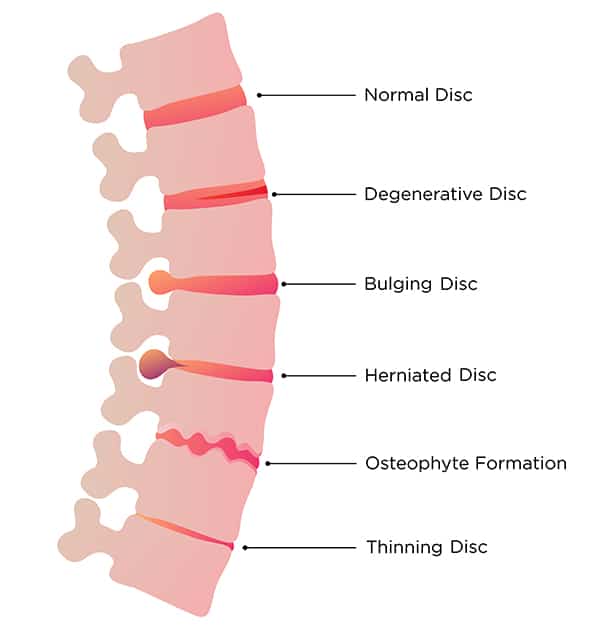
Dorsum pain is and so mutual it's almost inevitable. Like sprouting a gray hair, nearly people deal with at least one episode of depression back hurting by middle historic period. A major cause of back hurting can exist degenerative disc disease. Various factors, including what's happening both inside and exterior your cells, contribute to getting degenerative disc disease. A combination of wear and tear, poor diet in the discs, and neural changes over fourth dimension lead to degenerative disc illness. In this commodity, we'll get into what degenerative disc disease is and how you can treat information technology. To ameliorate understand degenerative disc illness, let's discuss the umbrella term under which information technology lies: low dorsum hurting. Low dorsum pain is the fifth virtually common reason people go to the doctor in the U.s.a.. Whether people are extremely active or relatively sedentary, healthy or unhealthy, back pain affects most people at some point in their lives. Of the many causes of dorsum pain, degenerative disc disease is the leading cause of lower back hurting and disability. 1 reason may be because our discs start degenerating much before than our bones and muscles, which we'll go into more detail on later. Allow's beginning by looking at the spine. Most people are born with a spine comprised of 33 bones called vertebrae stacked on acme of one some other like puzzle pieces. By adulthood we typically take 24 vertebrae considering the basic at the bottom of the spine fuse together. The vertebrae differ based on their location in the spine and have different functions in the neck (cervical), mid back (thoracic) and low dorsum (lumbar) regions. While degenerative disc disease can occur in whatsoever function of the spine, we'll focus on the virtually prevalent, the lumbar spine. Each lumbar vertebra is comprised of a prominent, round body in front, a pointy barbed process in back, a transverse process on either side, the spinal canal, which houses the spinal string, and facet joints, which articulate with the vertebra above it. When stacked together, they create the spinal cavalcade. The spinal column has four main functions: to support the weight of the torso above the pelvis, to protect the spinal cord, to act as the fundamental centrality of the body, and to control posture and movement. In between the bodies of the vertebrae lie intervertebral discs, which human action like soft pillows and provide flexibility and cushion to the spine. They as well allow for the spine's natural curvature, or lordosis, to absorb shock, provide stability, and behave heavier loads. Each disc is made upwardly of three parts: The nucleus pulposus plays the largest role in disc degeneration. A salubrious nucleus pulposus is gel-similar, well hydrated, and rich in proteins chosen proteoglycans. Information technology creates pressure in the disc to divide the vertebra, puts tension on the surrounding rings (annulus fibrosus) to hold the disc shape, and helps evenly distribute pressure over the terminate plates. Every bit we age, the nucleus pulposus loses proteoglycans, which causes the disc to go firmer, dehydrated, and more vulnerable to damage. These changes cause the disc to lose its height and pressure, which sets off a sequence of events that changes the biomechanics of the spine. Nucleus Pulposus Over Fourth dimension Disc degeneration over fourth dimension is inevitable. But many people going through it never even know it's happening. Discs begin the degeneration process every bit early as boyhood, with xx% of young people showing mild symptoms. Information technology'south when these changes cause painful and debilitating symptoms that we refer to it every bit degenerative disc disease, or intervertebral disc disease. Similar many other chronic weather condition, such equally heart disease and diabetes, no one specific issue causes degenerative disc illness. Degenerative disc disease results from a complex interaction of genetics, historic period, structural changes, biochemical changes, environment, trauma, and activity level over time. Iii main factors lead to the progression of degenerative disc disease: wear and tear, decreased nutrition in the discs, and neural changes. Natural disc degeneration can kickoff as early every bit ages eleven-16, merely most people brainstorm showing symptoms in middle age, subsequently they have put their spines through some wear and tear. Age-related changes crusade an imbalance between edifice tissue (anabolism) and breaking tissue down (catabolism). This changes the limerick of the nucleus pulposus, leaving it dehydrated and firmer. Equally disc height falls, the dynamics of the extracellular matrix (area surrounding disc cells) change, causing the once perfectly functioning spine to use altered movement patterns. With age, less nutrients are supplied to the discs, causing last end plates to harden and lapidify. Food loss also causes discs to be less capable of load distribution. Every bit one disc degenerates, information technology causes surrounding segments to work harder to distribute load and maintain postural stability, which accelerates degeneration of the surrounding discs. This in turn affects other structures, such as joints, ligaments and muscle. The discs in the spine are aneural (without nerves) and avascular (without claret vessels). So how practice they generate so much hurting? When the disc degeneration cycle progresses, a series of reactions are stimulated in which cytokines, the immune responses' signaling cells, are secreted. An inflammatory response follows, which can cause tears in the annulus fibrosis (fissures), push the disc into nerve tissue (bulge), or fifty-fifty cause the nucleus pulposus to rupture and leak out (herniate). Over fourth dimension, the spinal canal becomes also narrow (spinal stenosis) and compresses nerve tissue (radiculopathy), which causes hurting. If y'all are getting older by the twenty-four hours (hint: we all are!), then y'all are at risk of disc degeneration. Since discs begin degenerating much earlier than muscles and bones, many people who experience low back pain associated with degenerative disc disease are of working age. This may explain why degenerative disc disease is the leading crusade of piece of work-related disability. Some factors may put you at college gamble for developing degenerative disc affliction. Here are a few to go on in mind: Degenerative disc disease may be present in xc% of people over historic period 70. And so why don't xc% of people over historic period 70 have astringent low dorsum pain? Many people with degenerative disc disease are asymptomatic and will never need treatment. Others have episodic bouts of pain that are treatable with conservative interventions, which is why your physician usually won't jump right to ordering an MRI. Chances are, if y'all take back hurting, an MRI volition show some degeneration of your discs. Just that won't necessarily alter the form of handling. Managing symptoms is the priority. Besides the most obvious symptom of low back pain, the adjacent most common symptom is sciatica, or nervus blazon hurting running down the leg. This type of pain is commonly sharp and shooting and may feel numb and tingly radiating downwards the leg and foot. It tin can exist on one or both sides, and can follow what are called dermatomal patterns, or areas of the leg innervated by certain nerves. Specifying the location of your symptoms can help your clinician determine what level of the spine he or she suspects is involved. Your symptoms may be aggravated with angle, sitting, turning, coughing, sneezing, and occasionally continuing. Typically, if sitting aggravates your symptoms, then standing or laying will convalesce them, and vice versa. However, in an acute case of a disc herniation, it may be painful to be in any position. While degenerative disc disease symptoms may be painful, they aren't ordinarily dangerous. However, at that place are a few symptoms that require immediate evaluation past a medical professional. These can lead to rare, but potentially life-threatening complications: When seeking evaluation for degenerative disc disease, you must starting time choose where to begin for proper medical evaluation. Your primary care physician can diagnose your status, provide recommendations, and maybe medications to help temporarily, and this doc tin provide referrals for therapy, whether this be physical therapy or occupational therapy, depending on your condition. Your primary care physician can also assist you to find the most advisable specialist for your status -- and make this referral for you. This md may be an orthopedic physician, a physiatrist (PM&R physician), a neurologist, or a neurosurgeon. They all specialize in differing capacities in spinal dysfunction. No matter who you choose, it's e'er a good idea to know what to await. Your physician will enquire a series of questions about your medical history, current symptoms, aggravating factors, and alleviating factors, and any medications you've taken for this condition. Yous will be asked specific questions about your pain, such as location, quality, intensity, and frequency. They may examination your strength, flexibility, and range of movement. During this time, it is important to be honest: lay it all out in that location. Don't exist embarrassed to say yous fell off the railroad vehicle with your diet, or that you haven't left your couch since Covid-19 began. It'southward important for the physician to know what's going on in your life and so you can exist diagnosed accurately. While an MRI is the principal imaging technique for degenerative disc disease, it is simply one of many diagnostic tools a clinician may use. Remember that more probable than not, you have disc generation if you lot have depression back hurting. Since the results of an MRI often don't modify the treatment plan for the individual, physicians typically only order them if conservative treatment fails. Treatment typically starts with conservative management, which includes physical therapy, oral medications, injections, and education about agreement pain and coping mechanisms. Statistically, 80% of patients reply to concrete therapy inside iv to half-dozen weeks. For those who still endure from symptoms after trying conservative care, some promising prospects are less invasive than surgery but still being studied. Restorative therapies include molecular therapy, growth gene therapy, cell therapy and gene therapy. Reconstructive methods include percutaneous IVD techniques, mechanical decompression, and biomaterial injection. The more invasive treatments and typically last resort for symptom relief are decompression surgery, full disc replacement, and rigid fusion. While fusion protects the integrity of the segment, it may compromise other levels of the spine. Information technology also addresses symptoms, non causes of the condition. If you desire to decrease your risk of getting degenerative disc affliction, you can start by exercising. Exercise, particularly when washed in moderate to loftier volume, with depression repetition and frequency, tin decrease your adventure of having symptoms. Forth with a multitude of other wellness benefits, exercise will keep your postural muscles strong, spine stable, and cardiovascular system healthy. If you suffer from degenerative disc disease, don't lay around hoping it volition become away. Bedrest can make low dorsum hurting worse. After 1-2 days of residuum per new episode, it is important to movement your body. Your clinician volition directly you on what kind of activities are safe and effective for your case. Degenerating discs are about equally common as getting wrinkles with age. When they go painful and debilitating, however, we call it degenerative disc disease. Information technology is the result of a complex interplay of actions happening both within and outside of cells, environmental factors, genes, and change over time. If y'all accept an episode of low back pain, you may have degenerative disc affliction, merely don't schedule your surgery just yet. See your doctor and they will help you get back to being you!
What is Degenerative Disc Disease?
A Brief Look at Spine Anatomy
Where exercise Discs Come up into Play?
How Discs Degenerate
Age Filling Consistency Immature Jelly Middle-Anile Toothpaste Older Chalk What Causes Degenerative Disc Disease?

Wear and Tear
Decreased Diet in the Discs
Neural Changes
Am I at take a chance?

How do I know if I have Degenerative Disc Disease?
Symptoms
Things to Study Immediately
Diagnosis
What to do Most information technology
What Not to Do
Conclusion
Articles authored past Dr. Connor are intended to facilitate awareness about health and health matters more often than not and are non a substitute for professional medical attention or advice from your own healthcare practitioner, which is dependent on your detailed personal medical condition and history. You should always speak with your ain qualified healthcare practitioner about any information in any articles yous may read hither before choosing to act or not deed upon such information.
rodriguezastat1988.blogspot.com
Source: https://www.northwestpharmacy.com/askthedoctor/what-is-degenerative-disc-disease
0 Response to "What Can You Do for a Degenerative Disc"
Post a Comment