Required Fire Hydrant Flow Rate for One Family Residential Building in Nyc

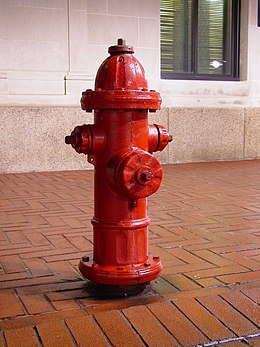
Fire hydrant in Charlottesville, Virginia, United States

Kawaii fire hydrant embrace in Shinbashi, Tokyo
A burn down hydrant or firecock (archaic)[1] is a connectedness point past which firefighters tin can tap into a water supply. It is a component of active fire protection. Underground fire hydrants accept been used in Europe and Asia since at to the lowest degree the 18th century. Above-ground pillar-type hydrants are a 19th-century invention.
History [edit]

Diagram from Otto Lueger'southward dictionary of technology, 1904
Before piped mains supplies, water for firefighting had to be kept in buckets and cauldrons set for use by 'bucket-brigades' or brought with a horse-drawn burn-pump. From the 16th century, equally wooden mains water systems were installed, firefighters would dig down the pipes and drill a pigsty for h2o to fill a "moisture well" for the buckets or pumps. This had to be filled and plugged afterwards, hence the common US term for a hydrant, 'fireplug'. A marker would be left to betoken where a 'plug' had already been drilled to enable firefighters to find ready-drilled holes. Later wooden systems had pre-drilled holes and plugs.[2] When cast-iron pipes replaced the wood, permanent hole-and-corner access points were included for the fire fighters. Some countries provide access covers to these points, while others attach fixed above-ground hydrants - the first bandage iron ones were patented in 1801 past Frederick Graff, so primary-engineer of the Philadelphia Water Works. Invention since then has targeted problems such as tampering, freezing, connexion, reliability etc.[three]
Performance [edit]

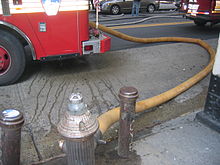
The user attaches a hose to the fire hydrant, then opens a valve on the hydrant to provide a powerful period of water, on the order of 350 kPa (50 pounds per square inch gauge (psig); this pressure varies according to region and depends on various factors including the size and location of the fastened h2o main). This user can attach this hose to a burn engine, which can apply a powerful pump to heave the water pressure and possibly divide it into multiple streams. One may connect the hose with a threaded connexion, instantaneous "quick connector" or a Storz connector. A user should take care not to open or close a fire hydrant besides chop-chop, as this can cause a water hammer, which can harm nearby pipes and equipment. The water inside a charged hose line causes information technology to be very heavy and high h2o force per unit area causes it to be stiff and unable to make a tight turn while pressurized. When a fire hydrant is unobstructed, this is not a problem, as there is enough room to adequately position the hose.
Near fire hydrant valves are not designed to throttle the h2o flow; they are designed to be operated full-on or total-off. The valving arrangement of most dry-butt hydrants is for the drain valve to be open at anything other than full functioning. Usage at partial-opening tin can consequently effect in considerable menstruation directly into the soil surrounding the hydrant, which, over time, tin crusade astringent scouring. Gate or butterfly valves can be installed directly onto the hydrant orifices to control private outputs and allow for irresolute equipment connections without turning off the flow to other orifices. These valves tin exist up to 12 inches in diameter to adjust the large central "steamer" orifices on many US hydrants. Information technology is good practice to install valves on all orifices before using a hydrant as the protective caps are unreliable and can crusade major injury if they fail.
When operating a hydrant, a firefighter typically wears appropriate personal protective equipment, such as gloves and a helmet with confront shield worn. High-pressure level water coursing through a potentially aging and corroding hydrant could cause a failure, injuring the fire fighter operating the hydrant or bystanders.
In most jurisdictions it is illegal to park a automobile within a certain distance of a burn down hydrant. In N America the distances are commonly 3 to 5 m or 10 to 15 ft, often indicated by yellow or ruby-red paint on the curb. The rationale backside these laws is that hydrants need to be visible and accessible in an emergency.
Other uses [edit]

Children playing in the spray of a fire hydrant in Philadelphia (1996)

Street pooling [edit]
In 1896, during a terrible heatwave in New York City, the Chief of Law, Theodore Roosevelt, ordered the opening of the fire hydrants to provide relief to the population.[iv] Today some United states of america communities provide depression flow sprinkler heads to enable residents to use the hydrants to cool off during hot weather, while gaining some control on water usage. Sometimes those merely seeking to play in the water remove the caps and open the valve, providing residents a place to play and cool off in summer.
Preventing misuse [edit]
To prevent coincidental use or misuse, the hydrant requires special tools to exist opened, usually a large wrench with a pentagonal socket. Vandals sometimes cause monetary loss by wasting water when they open hydrants. Such vandalism can also reduce municipal h2o pressure and impair firefighters' efforts to extinguish fires. Most burn hydrants in Australia are protected by a silver-coloured cover with a red top, secured to the ground with bolts to protect the hydrant from vandalism and unauthorized employ. The cover must be removed earlier use.
In most areas of the United States, contractors who need temporary water may purchase permits to use hydrants. The permit will generally require a hydrant meter, a gate valve and sometimes a clapper valve (if not designed into the hydrant already) to foreclose dorsum-menstruation into the hydrant. Additionally, residents who wish to utilize the hydrant to fill their in-ground swimming pool are normally permitted to practice so, provided they pay for the water and agree to allow firefighters to typhoon from their puddle in the instance of an emergency.
Municipal services, such as street sweepers and tank trucks, may too be allowed to employ hydrants to fill their water tanks. Ofttimes sewer maintenance trucks need water to flush out sewerage lines, and fill up their tanks on site from a hydrant. If necessary, the municipal workers will record the amount of water they used, or utilize a meter.
Since fire hydrants are one of the virtually accessible parts of a water distribution system, they are oftentimes used for attaching force per unit area gauges or loggers or monitor organisation water pressure. Automated flushing devices are often attached to hydrants to maintain chlorination levels in areas of depression usage. Hydrants are also used as an easy above-ground access point by leak detection devices to locate leaks from the audio they brand.
Burn hydrants may exist used to supply water to riot command vehicles. These vehicles use a high-pressure level water cannon to discourage rioting.
Construction [edit]
Depending on the country, hydrants tin can be above or below basis. In countries including Nihon, the UK, Ukraine, Russia or Spain hydrants are accessible under a heavy metallic comprehend. In other countries, such as the US, and many parts of China, an attainable part of the hydrant is above ground. It can also be mounted in an exterior wall of a building.

Hydrant installation in Ontario, Canada

Wall-mounted hydrant in San Francisco
In areas subject field to freezing temperatures, at about only a portion of the hydrant is above ground. The valve is located below the frost line and connected past a riser to the above-ground portion. A valve rod extends from the valve upward through a seal at the superlative of the hydrant, where it can be operated with the proper wrench. This design is known every bit a "dry out barrel" hydrant, in that the barrel, or vertical torso of the hydrant, is normally dry out. A drain valve underground opens when the water valve is completely closed; this allows all water to drain from the hydrant torso to prevent the hydrant from freezing.
In warm areas, higher up-ground hydrants may be used with i or more than valves in the above-ground portion. Unlike with cold-weather hydrants, it is possible to turn the h2o supply on and off to each port. This way is known as a "wet butt" hydrant.
Both wet- and dry out-barrel hydrants typically have multiple outlets. Wet barrel hydrant outlets are typically individually controlled, while a single stem operates all the outlets of a dry barrel hydrant simultaneously. Thus, moisture butt hydrants let single outlets to be opened, requiring somewhat more effort, but simultaneously allowing more than flexibility.
A typical U.S. dry-butt hydrant has two smaller outlets and one larger outlet. The larger outlet is often a Storz connection if the local burn section has standardized on hose using Storz fittings for large bore supply line. The larger outlet is known every bit a "steamer" connectedness, because they were one time used to supply steam powered h2o pumps, and a hydrant with such an outlet may be called a "steamer hydrant", although this usage is condign archaic. Likewise, an older hydrant without a steamer connection may be chosen a "hamlet hydrant."
Appearance [edit]
In a higher place basis hydrants are coloured for purely practical criteria or more aesthetic reasons. In the United States, the AWWA and NFPA recommend hydrants be colored chrome yellow[5] for rapid identification apart from the bonnet and nozzle caps which should exist coded according to their available flow. Class AA hydrants (>1500 gpm) should have their nozzle caps and bonnet colored lite blue, Form A hydrants (1000–1499 gpm) light-green, Class B hydrants (500–999 gpm) orange, Class C hydrants (0–499 gpm) reddish, and inoperable or end-of-system (risking water hammer) black. This aids arriving firefighters in determining how much h2o is available and whether to call for additional resources, or find another hydrant. Other codings can be and frequently are used, some of greater complexity, incorporating pressure data, others more simplistic. In Ottawa, Ontario, hydrant colors communicate different letters to firefighters; for instance, if the inside of the hydrant is corroded so much that the interior diameter is too narrow for good pressure, it volition be painted in a specific scheme to bespeak to firefighters to motility on to the adjacent i. In many localities, a white or regal pinnacle indicates that the hydrant provides not-drinkable h2o. Where artistic and/or aesthetic considerations are paramount, hydrants tin be extremely varied, or more subdued. In both instances this is ordinarily at the cost of reduced practicality.
In Germany, the Netherlands, Spain, the U.k., and many other countries most hydrants are located beneath basis and are reached by a riser, which provides the connections for the hoses. The covers can also be artistically designed (See Japanese example in a higher place).
-

Hydrant in the United states painted with an American patriotic theme
-

Hydrant in the Philippines
-

German secret hydrant with Storz hose connections
-
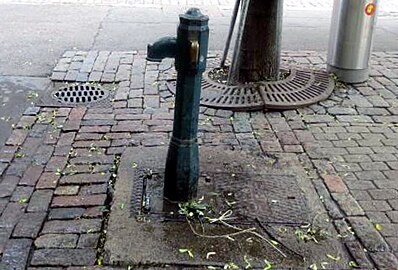
Hydrant at Fredantori square in Helsinki, Republic of finland
-

Czech example
-

Greek example
-

Brazilian example
-
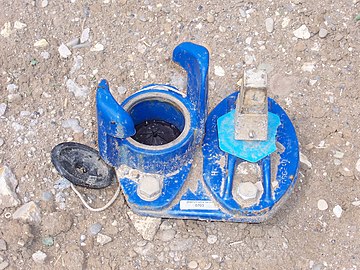
German language secret case
-

Spanish cover in Barcelona, Espana
-
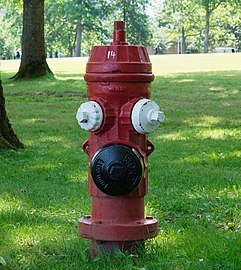
Fire hydrant in British Columbia
-

Birdsill Holly hydrant side view from urban center h2o supply pipeline right-of-fashion land
-

Birdsill Holly hydrant top view with description and patent date information
-

2016 modern fire hydrant
-

Forrad hydrant nozzle
-

Hydrant nozzle side view
-

Burn hydrant five sided top nut
-

Firefighter uses hydrant
Signage [edit]

Hydrant sign in Cork, Ireland, dated 1858. The letters "FC" signal the old proper name for a hydrant: firecock.

British fire hydrant and sign — the sign indicates the hydrant is 100 mm in diameter and ane metre from the sign.


Underground hydrant in Russia, marked with a plate and a carmine cone

Red fire hydrant marking plate in Frg, along with another bluish special-purpose water hydrant mark plate - The numbers point the diameter (lxxx mm) and the location (2.eight meter in the dorsum, 1.v meter to the right).
In the U.k. and Ireland, hydrants are located in the basis.[half-dozen] Yellow "H" hydrant signs indicate the location of the hydrants, and are similar to the blue signs in Finland. Mounted on a small-scale mail or nearby wall etc., the two numbers indicate the diameter of the h2o primary (top number) and the altitude from the sign (lower number). Modern signs show these measurements in millimetres and metres, whereas older signs use inches and feet.[7] Because the orders of magnitude are and so dissimilar (half dozen inches versus 150 mm) there is no ambivalence whichever measuring system is used.
In areas of the Us without wintertime snow cover, blue reflectors embedded in the street are used to allow rapid identification of hydrants at nighttime. In areas with snow cover, tall signs or flags are used and then that hydrants can be found even if covered with snow. In rural areas tall narrow posts painted with visible colours such as crimson are attached to the hydrants to allow them to be found during heavy snow periods. The tops of the burn down hydrants indicate the amount of force per unit area each one volition put out; the color helps make a more accurate choice of what hydrants volition be utilized to supply water to the burn scene.[eight]
- Blueish: 1500 GPM or more; very skilful menstruum
- Dark-green: one thousand–1499 GPM; proficient for residential areas
- Orange: 500–999 GPM; marginally acceptable
- Cerise: beneath 500 GPM; inadequate
The hydrant bodies are also color-coded.
- White: Public Arrangement Hydrant
- Yellow: Private Organisation Hydrant; continued to public water main
- Red: Special Operation Hydrant; not used except for special procedures
- Violet: Non-potable supply; effluent, pond or lake supply
These markings and colours are required by the NFPA(National Fire Protection Bureau).[eight]
In Australia, hydrant signage varies, with several types displayed across the state. Virtually Australian hydrants are underground, being of a ballcock arrangement (spring hydrant type), and a separate standpipe with a key plunger is used to open the valve. Consequently, hydrant signage is essential, because of their concealed nature.
- Painted markers – Ordinarily a white or yellowish (sometimes reflective paint) triangle or arrow painted on the road, pointing towards the side of the road the hydrant volition be found on. These are most common in old areas, or on new roads where more than advanced signs have not been installed. These are almost always coupled with a secondary form of signage.
- Hydrant Marker Plates – Plant on power poles, fences, or street-signs, these are a comprehensive and effective organisation of identification. The plate consists of several codes; H (Potable water Hydrant), RH (Recycled/Non Potable), P (Pathway, where the hydrant cover can exist found), R (Roadway). The plate is vertically oriented, around eight cm wide, and 15 cm high. Information technology usually faces in the management of the hydrant. Found on this plate, from acme to lesser, are the following features:
- The codes listed above, Drink/Non-drink at the top, Path/Roadway on the lesser of the plate.
- Below this, a number giving the distance to the hydrant (in meters), then a 2nd number below that giving the size (in millimeters) of the water master.
- A black line beyond the center of the plate indicates the hydrant is institute on the reverse side of the route to which the plate is affixed.
- Plates for recycled water have a royal background, as well as the RH lawmaking, normal beverage hydrants are white, with the H code.
- Road markers or True cat's eyes – Almost exclusively blue, these are placed on ane side or the other of the center line of the road, to indicate on which side of the road the hydrant lies. They are visible for several hundred meters at night in heavy rain, further in articulate conditions.

A blue reflector marks the location of the fire hydrant.
In Federal republic of germany the hydrant marker plates follow the fashion of other marker plates pointing to underground installations. Fire hydrant marker plates have a red edge. Other water hydrants may have a blue border. A gas hydrant would have a yellowish background instead of a white one for burn down hydrants. All of them have large primal T with the installation identification on top of it - an "H" or older "UH" is located in the footing, a "OH" is above ground, followed by the pipe inner bore in millimeters (with a small 80 mm in residential areas). The numbers around the T allow to locate the installation in reference to the plate's location - the number left of the T is in meter left of the sign, the number right of the T is in meter right of the sign, and number below the T tells the distance in meter in front of the sign, where a negative number would point to a place behind the sign. The distance numbers are e'er given with a comma decimeter precision. If it is not a common burn hydrant type so another identification may be used, for example "300 m³" would point to a cistern usable to pump water from.
In East Asia (China, Japan and South korea) and one-time Socialist countries of Eastern Europe, there are 2 types of burn down hydrants, of which one is on the public ground and the other inside a building. The ones within a building are installed on a wall. They are big, rectangular boxes that also provide alarms (sirens), a burn down extinguisher and, at sure times, emergency kits.
Inspection and maintenance [edit]

A fire hydrant that was hit by a snow plough and knocked over. Notation that just the sacrificial bolts were damaged.
In most areas, fire hydrants require annual inspections and maintenance; they commonly just accept a one-year warranty, just some have 5- or even ten-yr warranties, although the longer warranty does not remove the need for periodic inspections or maintenance. These inspections are mostly performed by the local municipalities or burn departments but they oft do non inspect hydrants that are identified equally private. Private hydrants are normally located on larger backdrop to adequately protect large buildings in example of a fire and in order to comply with the fire code. Such hydrants accept met the requirements of insurance underwriters and are frequently referred to as UL/FM hydrants. Some companies are contracted out to inspect private burn down hydrants unless the municipality has undertaken that job.


A burn hydrant without a diffuser, flushing discolored h2o
Some fire hydrant manufacturers recommend lubricating the head machinery and restoring the head gaskets and O-rings annually in order that the burn hydrant perform the service expected of them, while others have incorporated proprietary features to provide long-term lubrication of the hydrant'due south operating mechanism. In whatsoever case, periodic inspection of lubricants is recommended. Lubrication is generally done with a food-class non-petroleum lubricant to avert contamination of the distribution system.
Occasionally a stone or foreign object will mar the seat gasket. In this case, most hydrants have a special seat wrench that allows removal of the seat to supercede the gasket or other broken parts without removing the hydrant from the basis. Hydrant extensions are also available for raising a hydrant if the grade around the hydrant changes. Without extending the pinnacle, the wrenches to remove caps would not clear and the interruption flanges for traffic models would not be located correctly in case they were hit. Hydrant repair kits are also available to repair sacrificial parts designed to break when hit by a vehicle.
Many departments utilise the hydrants for flushing out water line sediments. When doing then, they often use a hydrant diffuser, a device that diffuses the h2o and so that it does not impairment property and is less unsafe to bystanders than a solid stream. Some diffusers also dechlorinate the water to avoid ground contamination.[9] Hydrants are also sometimes used every bit entry or exit points for pipe cleaning pigs.
In 2011, Code for America adult an "Adopt a Hydrant" website, which enables volunteers to sign up to shovel out fire hydrants after snowstorms. Equally of 2014, the system has been implemented in Boston; Providence, Rhode Island; Anchorage, Alaska; and Chicago.[x]
Non-pressurized (dry out) hydrants [edit]

In rural areas where municipal h2o systems are not available, dry hydrants are used to supply water for fighting fires. A dry hydrant is analogous to a standpipe. A dry hydrant is usually an unpressurized, permanently installed pipe that has one end below the water level of a lake or pond. This end usually has a strainer to prevent debris or wild animals, such as fish, from entering the pipe. The other finish is above ground and has a hard sleeve connector. When needed, a pumper burn down engine will pump from the lake or pond by drafting water. This is done past vacuuming the air out of the dry hydrant, hard sleeve, and the burn down engine pump with a primer. Because lower pressure at present exists at the pump intake, atmospheric pressure on the water and the weight of the water forces water into the above-water portion of the dry hydrant, into the hard sleeve, and finally into the pump. This water can so be pumped by the engine'due south centrifugal pump.
Other types [edit]
- Water wells are too sometimes classified every bit fire hydrants if they tin supply enough water volume and pressure.
- Standpipes are connections for firehoses within a building and serve the same purpose inside larger structures as fire hydrants practise outdoors. Standpipes may be "dry out" or "moisture" (permanently filled with water); a dry standpipe requires an external source of water such as firefighting equipment.
See also [edit]
- Active fire protection
- Birdsill Holly
- Fire extinguisher
- Fire hose
- Fire protection
- Burn sprinkler
- Flushing hydrant
- Hydrant wrench
- Portable h2o tank
References [edit]
- ^ "Firecock | Definition of Firecock by Oxford Dictionary on Lexico.com". Lexico Dictionaries | English . Retrieved 2020-x-22 .
- ^ The History of Germ-free Sewers Retrieved August 2019
- ^ Firehydrant.org Accessed Aug 2019
- ^ Marc Bettinelli « Street pooling » : d'où vient cette idée d'ouvrir des bouches à incendie en période de canicule ? Le MOnde, 26 June 2017
- ^ "National Fire Protection Clan Study (p. 18)" (PDF). National Burn down Protection Association (NFPA). August 15, 2013.
All barrels are to exist chrome xanthous except in cases where some other color has already been adopted.
- ^ BS 750: "Specification for underground burn down hydrants and surface box frames and covers" (2012).
- ^ "Adept Stewardship for Schools Premises p. eighteen" (PDF). Cambridgeshire County Council. 2009. Archived from the original (PDF) on March 4, 2012.
- ^ a b Lamm, Willis. "Hydrant color codes and markings". Fire hydrant.org. Water supply office. Retrieved 31 March 2015.
- ^ "Hydrant Flushing FAQ, U.s. of America" (PDF).
- ^ Raja, Tasneem (2014). "Is Coding the New Literacy?". Mother Jones . Retrieved 2014-06-21 .
Sources [edit]
- Hinds, Conrade C. (nine October 2012). The Corking Columbus Experiment of 1908: Waterworks that Changed the World. Arcadia Publishing. ISBN978-1-61423-685-half-dozen.
Further reading [edit]
- U.Due south. Patent 909 — Issued to John Jorden on September 8, 1838 for "...a new and useful improvement in Burn-Plugs and Hydrants...". This is an early wooden bodied hydrant, the earliest hydrant patent extant; the patent office itself burned to the ground in 1836, taking with it all prior hydrant patents.
- U.S. Patent 37,466 — Issued to Richard Stileman on January twenty, 1863. An early iron hydrant, believed the showtime patented hydrant with the larger size steamer port to supply steam burn down engines. Manufactured and marketed as the Stileman hydrant. Encounter likewise Stileman page at FireHydrant.org.
- U.Due south. Patent eighty,143 — Issued to Zebulon Erastus Coffin on July 21, 1868. This is a cast iron hydrant very like to modern burn down hydrants, it was produced by Boston Machine Co. Run into as well Boston Machine page at FireHydrant.org.
- U.S. Patent 94,749 — Issued to Birdsill Holly on September fourteen, 1869. See also Holly page at FireHydrant.org.
- Wohleber, Curt. "The Fire Hydrant". In The American Heritage of Invention & Applied science. Winter 2002. Provides a history with dates of fire hydrant evolution. (Archived from the original on Apr 28, 2010)
External links [edit]
rodriguezastat1988.blogspot.com
Source: https://en.wikipedia.org/wiki/Fire_hydrant
0 Response to "Required Fire Hydrant Flow Rate for One Family Residential Building in Nyc"
Post a Comment