But Then Again You Guys Have a Problem With My Fam Canon
Space Jam 2: Has Hollywood animation woken up to racism?
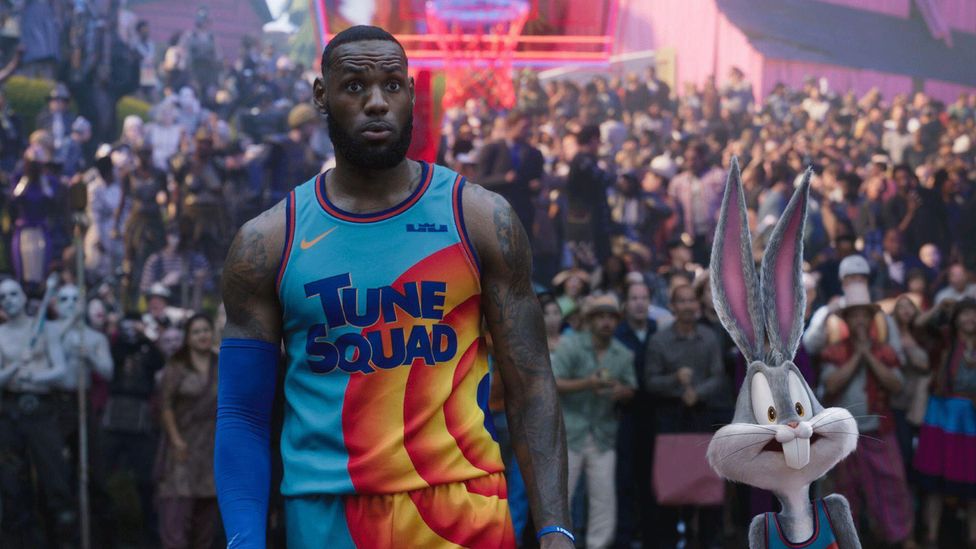
In 1996, cartoon mash-up Space Jam was pioneering in centring a potent black lead. Now, equally a sequel comes out, has Hollywood animation as a whole caught up, asks David Jesudason.
W
When picking the nearly pioneering films of the 1990s, Space Jam might not seem the nigh obvious contender. Zany and loftier-concept, the 1996 Warner Bros flick was an extension of a 1992 Super Bowl Nike commercial, in which Hashemite kingdom of jordan had starred alongside Bugs Bunny. With the assistance of the full gang of Looney Tunes cartoon characters, it creates an alternative reality, imagining what Jordan might accept done betwixt his retirement from the NBA in 1993 and his incredible comeback 2 years later – that is, assistance Bugs and Co win a basketball game game confronting some evil aliens in social club to secure their freedom. Featuring a mixture of animation and live activity from actors, including Jordan, Bill Murray and Seinfeld's Wayne Knight, it was joyfully absurd and designed to brand the mind boggle.
More like this:
– Ten films to spotter in July
– How Hollywood whitewashed war
– Is it the stop of the all-white catamenia drama?
However, amid all the silliness, it also offered something more profound – a defining moment for black representation in cinema. At the center of this big-budget Hollywood animation was not just a black atomic number 82, but in Jordan, a black superstar, an icon, and an all-American family unit man. (In fact Hashemite kingdom of jordan was such a big deal at the time that, as shown in the contempo Netflix documentary series about him, The Concluding Dance, he was able to get the studio to construct a court for him to practice on, where he played with other NBA stars.) Progressiveness may not have been its first concern, and the interim required of Jordan was inappreciably a stretch, but within the context of Hollywood animated family films and their history of both racial erasure and racist stereotyping, it was ground-breaking.
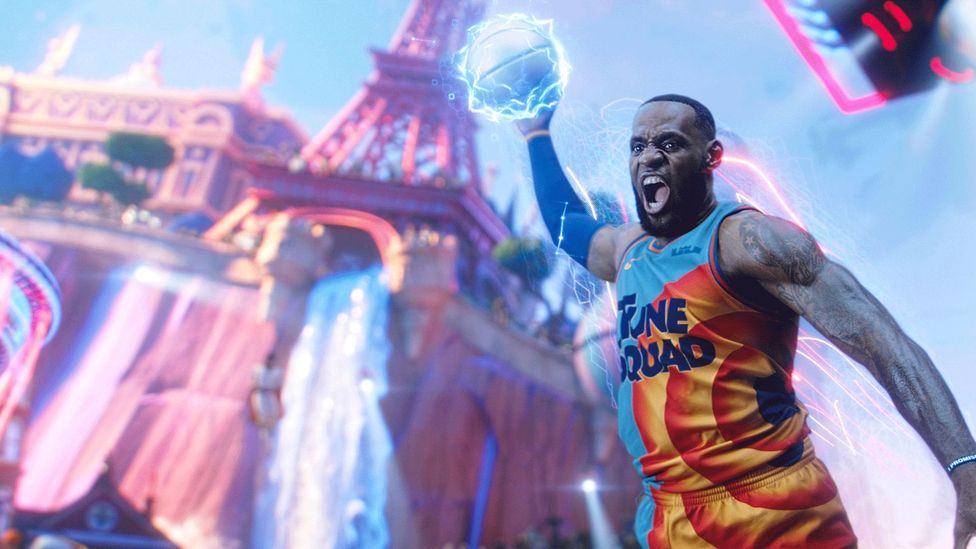
Space Jam: A New Legacy sees the Looney Tunes crew teaming up with some other basketball legend, LeBron James, replacing original star Michael Jordan (Credit: Alamy)
Behind the camera, information technology was also notable for having an animation co-managing director, Bruce W Smith, who was one of the few black animators working in Hollywood – something that is, depressingly, even so the case today. "I realise that our animation business is probably made upward of 3-5% African Americans," said Smith, who also created Disney's pioneering black cartoon series The Proud Family, at an event terminal year. "Therefore, yous won't get a lot of African-American content on the screen from an African-American standpoint because the people aren't there at the table to put us in primary parts of films."
However, now a Infinite Jam sequel arrives in an at-least somewhat unlike landscape. Released around the world this week, Space Jam: A New Legacy is a loud, advised retread of the original, and stars some other basketball game legend, LeBron James, aslope both blithe and CGI versions of the Looney Toons coiffure. This fourth dimension, though, the production has a blackness director (with Malcolm D Lee replacing Joe Pytka), Ryan Coogler of Blackness Panther fame among its producers, and an nigh all-black alive-action cast.
The upshot is a sequel that, without giving too much away, handles race with a deft touch. Meanwhile its characterisation of James' protagonist is more nuanced than Jordan's driven sportsman. He'southward shown to be a secret "nerd" who regrets repressing his childhood love for Gameboys and adores Harry Potter, while central to the fanciful plot this time is his relationship with his son, Dom (played by Cedric Joe), as both are sucked into Warner Bros' servers where they have to play a basketball match to defeat the evil Al-G Rhythm (Don Cheadle) who controls Warner Bros' virtual globe. The but existent problem with this film is the endless nods to other Warner Bros properties – with characters from The Flintstones and Male monarch Kong to, heed-bogglingly, the droogs from A Clockwork Orangish popping up. These seem less like meta-jokes than adverts for the studio's back catalogue and obstruct the picture show's pleasures.
Whereas, in the mid-1990s, the original Space Jam felt like a lone pioneer, its sequel is office of an era in Hollywood animation that is offset to show signs of modify. There are more new films including characters of colour just as the racist tropes of some of the genre'southward virtually famous old films are being reckoned with – to the point at present where some even come with warnings when accessed on streaming platforms.
The cached history of cartoons
Racism within the animation genre is certainly deeply ingrained. Looking at Bugs Bunny and Mickey Mouse it would be difficult to imagine anything other than innocent fun, however their conception was based entirely on racial stereotyping. As Nicholas Sammond, Associate Professor of Movie theatre Studies at the University of Toronto, explored in his 2015 volume Nativity of an Industry: Blackface Minstrelsy and the Rise of American Animation, many drawing characters from the early days of film and TV, such as Mickey and Bugs, take their roots in minstrel shows. He writes how these characters began "visually and gesturally act[ing] equally minstrels but over time lose a direct association with blackface itself". This influence is also partly the reason why characters similar Mickey and Goofy are always depicted wearing white gloves.
In other cases, the historical racism is much more apparent. Ane film, no longer bachelor to watch or buy through any channels, exemplifies the legacy Hollywood has to redress. Disney'due south 1946 motion picture Song of the South – a mix of live-action and animation, like the Infinite Jams – tells the story of plantation workers after the abolitionism of slavery and contains then many offensive depictions of blackness people that it was dubbed "i of Hollywood'due south most resiliently offensive racist texts" by Jason Sperb in his book Disney'south Most Notorious Film. Subsequently deciding not to put it on its Disney + service, last year Disney besides announced they were refitting their Splash Mountain log flume ride, originally inspired by the film, to remove any Song of the South elements.
Despite that pic beingness excised from the family canon, however, in that location are still enough of films within information technology that have a pretty plainly troubling human relationship with race. Take some other much-loved pic from the aforementioned era, 1941'south Dumbo, which features crows acting out minstrel show routines – led by 'Jim' Crow, a character name riffing off the notorious pejorative term for black people that came to be associated with racial segregation laws in the United states – and a vocal with the lyrics "We slave until we're almost expressionless/ We're happy-hearted roustabouts". And all through the residual of the 20th Century, people of color continued to be egregiously stereotyped. "The film that radicalised me confronting Disney was [1992's] Aladdin," says Hemant Shah, a professor at the University of Wisconsin-Madison who studies portrayals of race and ethnicity in picture and media. "Because that's where the imagery of the Heart East was so highly problematic. Even the theme song [Arabian Nights] would talk about how barbaric the Centre Due east was and how they would cut off your ear if they don't similar your face up." It also featured an all-white bandage of vox actors.

Disney's Aladdin is among the archetype animations that accept proffered egregious racial stereotypes (Credit: Alamy)
In the last decade or so, some progress has been made. Major new animated releases, from 2009'south The Princess and the Frog to 2020's Soul, have centred black characters and characters of color. And Disney, in particular, has conspicuously tried to correct itself: two years ago, Aladdin was reworked with a live activeness remake; it featured Will Smith equally the genie as part of a various cast including numerous actors of Center Eastern descent, and cut the more problematic lyrics from its songbook.
Still whether these efforts count every bit truly progressive is debatable. In Aladdin's instance, information technology could be argued that the very aesthetic of information technology is inherently racist, says Dan Hassler-Woods, popular cultural theorist and banana professor of media studies at Utrecht University. "To cater to fans [Disney] make small-scale adjustments only [there is still the fact] that the whole framework of Aladdin is this Western Orientalist playground that is presented every bit a kind of entertainment park of stereotypes."
As for 2009's The Princess and the Frog, with its lead grapheme Tiana, the outset African-American Disney princess, it certainly challenged the default of white blonde princesses, but that attempt at multifariousness suffered from Tiana existence transformed into a frog for about of the movie and the use of racially stereotypical tropes, such every bit voodoo, and a cliched New Orleans jazz setting. Similarly, Pixar's Soul has a black pb, music teacher-cum-jazz pianist Joe, but then kills him almost immediately and turns him into a posthumous blob, while then putting another soul, voiced by a white woman, Tina Fey, into his body. What'south more, in one scene Joe is mistaken for some other black man, an archetypal racist microaggression, which feels like it is scripted without any sensation of that fact.
Why practise such missteps still happen? Perhaps it'southward considering, on a systemic level, the industry hasn't changed as much equally it would like to projection. Directors of the big blithe films are still predominantly white men, while companies like Disney are money-making machines that follow formulas based on previous success. Soul did take a black co-manager, Kemp Powers, just he was only drafted in late into the product process.
Notwithstanding Disney maintain that they are putting resources into redressing this systemic inequality. "We accept several programmes that back up the pipeline of diverse creative talent [in blitheness] including Pixar Spark Shorts [and] Launchpad," a Disney spokesperson tells BBC Culture. They add together that the studio has also recently launched Onyx Collective, a content platform to showcase work by creators of colour and other underrepresented voices, while in the Uk, they have "collaborated with the BFI's Future Skills program" which is designed to help provide preparation and opportunities to immature people from a variety of backgrounds.
The signs of progress
On screen, at that place are also signs that companies like Disney are trying to accost the racist legacy of animation in a more deeply considered way. One contempo example of this is Disney'due south Raya and The Last Dragon. Released in March, and telling the story of a immature warrior princess, it is the first Disney film to feature a south-east Asian lead, and is co-written by Adele Lim, who is of Malaysian-Chinese descent. It has been met with huge acclaim from south-east Asian viewers for the particular in its representation, including its characters' spectrum of peel tones, its accurate adoption of cultural signifiers, like the use of food equally hospitality, and its realistic delineation of martial arts. Then later on in the year the studio'south adjacent big blithe release will exist Encanto, which has a story prepare in and inspired by Colombia. Notably, it features a bandage of voice actors who are all either Colombian or of Colombian heritage and has a Latino female co-director, Cuban-American Charise Castro Smith, while the pre-publicity has been bang-up to assert its authentic credentials past pointing out that "the filmmakers were deeply inspired by their research trip to Republic of colombia during early development of [the moving picture] besides equally their continuous work with a group of expert consultants".
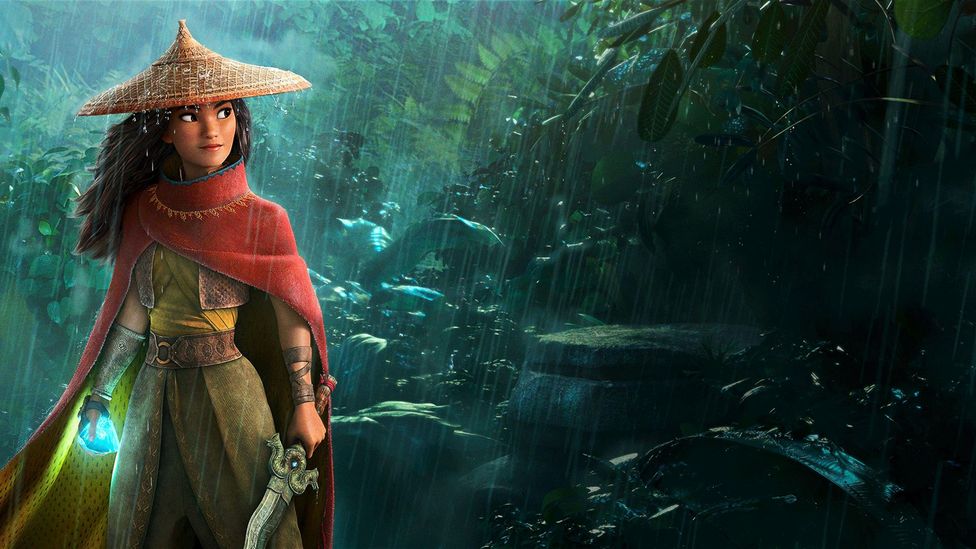
Disney's recent release Raya and the Last Dragon met with acclaim for the item of its S-eastward Asian representation (Credit: Alamy)
Watching Raya and the Last Dragon had a particularly personal touch on on me: my mother is Malaysian so seeing the rice dish nasi lemak depicted lovingly in a Disney film was a watershed moment for me, having grown up feeling that my civilization was overlooked in the animations I loved. It has been criticised for lumping together all south-east Asian civilisation into five groups and for its use of voice actors who take eastward Asian heritage, only overall Raya feels like a genuine effort by Hollywood to respect a not-Western culture and the perfect tool to teach my five-year-old daughter that princesses don't accept to await similar Frozen's Elsa.
It contrasts with another film that recently purported to celebrate Asian culture, but did so more superficially: Netflix'southward Over the Moon, which tells the story of a young girl in a Chinese hamlet trying to build a rocket to wing to the moon. While information technology represents both Chinese and Chinese-American culture, it at times veers into clichés – the adults participate in outdoor calisthenics, chimera tea is drunk a lot – that suggest a white person'due south view of Due east Asians, which is no surprise as information technology was both directed and written past white Americans with "additional material" added by two Asian-American screenwriters.
The biggest strides take been happening in blackness representation. Although Soul had its faults, it did depict New York's black community in a touching way, non least in its portrayal of Joe's neighbourhood barbershop, while every bit it evoked the jazz music scene with intendance and attention, both in its visuals and soundtrack.
Before that, in 2018, the animated Marvel and Sony Pictures release Spider-Man: Into the Spider-Verse offered the progressive template for how to successfully create a more various story that addresses race and racial prejudice in a subtle yet thoughtful way. Co-directed by trailblazer Peter Ramsey, who was the commencement African-American to both exist nominated for and win the best animated feature Academy Honour for it, it tells the story of a young Afro-Latino boy, Miles Morales, who gets bitten by a radioactive spider and acquires ability like to Spiderman. Among the superhero antics, it shows Morales struggling with fitting in in his majority white elite schoolhouse, while he has a touching relationship with his policeman father, who is focused on providing his son with academic opportunities, that rebuffs negative stereotypes nigh black fatherhood. "It's a terrific instance of how a story can draw on [a familiar franchise] while reframing information technology in a way that is really meaningfully nearly race without beingness didactic most information technology." says Hassler-Forest.
Last month, it was announced Issa Rae would be voicing a black Spiderwoman in the motion-picture show's sequel, which will over again bonfire a trail for Hollywood animation in not only centring a black adult female, simply an activity heroine rather than a princess.
Why this matters and then much as a parent
The importance of diverse representation in animation has truly hit home to me since I became a parent. Unfortunately, Spider-Human being: Into the Spider-Verse is aimed at an older age-group than that of my daughter and, while it'south heartening that a film like Raya and the Last Dragon at present exists, information technology is difficult to get a child of that age to deviate from the familiar when they are already obsessed with a cultural juggernaut similar Frozen, whose merchandise and marketing is everywhere. That obsession has become a bigger problem than I thought information technology would be equally, in her love for Elsa, my daughter has started to equate blondeness with beauty, ability and strength which has led her to e'er try to seek out friends who are white girls.

Spider-Man: Into the Spider-Verse (2018) was a perfect case of how to create a more diverse kids' animation (Credit: Alamy)
"It'south hard to gainsay the power of Elsa," says Sarah Coyne, associate manager of the School of Family Life at Brigham Young University, Utah. "Just it's of import to point out the misperception that blonde people are better than any other type of people. And talk to the teacher and address this at the school level, then she'south hearing it from lots of dissimilar people".
Even so, while this is something that my partner and I take indeed tried to address with the assist of teachers, we've had mixed results, equally it'south such a huge systemic trouble that it can't exist overturned by a few conversations in the playground. Information technology's a problem though that Shah thinks Disney tin can really do a lot more to help with. Currently, the merely teaching resource on negative stereotypes the media company provides is a website that goes through their animations' history of offensive imagery. As mentioned before, the company also provides warnings before certain films on streaming platforms, such as Aladdin, but these will only take any real impact if they're backed up with an adult explaining why exactly the depictions being warned almost are offensive. "What's missing is a more comprehensive media literacy component," explains Shah. "They could create materials that they could share with schools and parents to talk virtually why [sure] images are problematic."
In the meantime we're left with a situation in which new animation films are pushing to create a more diverse mural, with mixed results, while systemic racism yet casts a shadow over the genre. The Infinite Jam films are actually the perfect amalgamation of this trouble, featuring as they do both strong black part models and outdated drawing characters, like Speedy Gonzales (based on offensive Mexican stereotypes) and Bugs Bunny, who, equally mentioned above, was originally inspired past minstrel performers. "[With Bugs Bunny aslope Michael Jordan and LeBron James] nosotros're seeing two different versions of how America views blackness and one version that doesn't actually acknowledge their race or racial identity," as Hassler-Forest puts information technology.
Notwithstanding, while the presence of Bugs Bunny may be a throwback to historical bigotry, Space Jam and now its sequel at to the lowest degree prove some of the way forward for Hollywood blitheness in reckoning with its race problem, and centring stories with strong nuanced characters of colour. Indeed, when my daughter is onetime enough, I'd love for her to relish the Space Jams and to be lost in a virtual world where blonde is non the default. These films may seem like wacky inanity simply for parents similar me, they tin exist used to show our children that there's an alternative to white culture – and that is far from frivolous.
David Jesudason is a freelance journalist who writes about culture and has a weekly newsletter Episodes of My Life on Substack
Love film and TV? Join BBC Culture Film and Tv Club on Facebook, a community for cinephiles all over the world.
If you would like to comment on this story or anything else you have seen on BBC Culture, caput over to our Facebook folio or bulletin us on Twitter .
And if you liked this story, sign up for the weekly bbc.com features newsletter , called The Essential Listing. A handpicked selection of stories from BBC Future, Culture, Worklife and Travel, delivered to your inbox every Friday.
rodriguezastat1988.blogspot.com
Source: https://www.bbc.com/culture/article/20210715-has-hollywood-animation-truly-left-racism-behind
0 Response to "But Then Again You Guys Have a Problem With My Fam Canon"
Post a Comment