Its Me Again Lord Blind Slye Twins

I must refer my readers to a new recording of some Gregorian chant from Silverstream Priory. The beautiful responsory, Media Vita, is very timely during this pandemic. Hither is the translation, passed on by the Prior:
Translation of the Media VitaIn the midst of life we are in decease; from whom shall we seek help, relieve Thee, O Lord? Who for our sins art justly angered. * Holy God, Holy mighty I, Holy merciful Saviour, mitt united states of america not over to the bitterness of death.
1. In Thee our fathers hoped; they hoped, and 1000 hast liberated them. * Holy God, Holy mighty I, Holy merciful Saviour, hand usa non over to the bitterness of death.
two. To Thee our fathers cried; they cried and were not confounded. * Holy God, Holy mighty 1, Holy merciful Saviour, manus united states of america not over to the bitterness of death.
3. Glory be to the Male parent, and to the Son, and to the Holy Ghost. * Holy God, Holy mighty One, Holy merciful Saviour, paw united states of america not over to the bitterness of decease.
I know I speak for the monks when I encourage yous to give it a heed and take some comfort from this ancient prayer of the Church in a fourth dimension when death is all around.
I would particularly note the highly idiosyncratic harmonic arrangement used here. I have non heard any other renditions of this dirge similar it. I grew up listening to the Benedictines of Santo Domingo do Silos, and although I like their hauntingly pure Media Vita, the Silverstream version has a complexity and depth that feels very different, if merely as moving.
The accompanying flick is also of very loftier quality. I take known the monks of Silverstream for six years. This is by far the best video I've seen from them. It does a skilful job capturing the peculiar beauty of that monastery in Springtime, besides as the powerful sense of holiness that radiates throughout the house and grounds from the Blessed Sacrament. And for those who intendance about such things, in that location's a lovely conical requiem chasuble from 3:23 on.
Give it a listen, and please consider supporting the monks through a donation or by shopping at their excellent online store. The monks are streaming their masses and some of their offices throughout this crisis, and I recommend following them for what will no incertitude be a stirring and holy Paschal Triduum (albeit at a distance).
Earlier this week, I went to the Birmingham Oratory for the Feast of Bl. John Henry Newman. Fr. Ignatius Harrison, the Provost, was kind enough to open the Oratory firm to me. I must offer him my tremendous thanks for his hospitable willingness to permit me see such an incredible (and, it must be said, holy) place. Likewise, I thank Br. Ambrose Jackson of the Cardiff Oratory for taking fourth dimension out of his decorated schedule to give me what was an extraordinarily memorable tour. I went away from the experience with a rekindled devotion to Cardinal Newman.

Your humble retainer in Fundamental Newman'southward ain library. Photo taken by Br. Ambrose Jackson of the Cardiff Oratory. You can meet Central Newman's violin case on the lower shelf of his standing desk at right.
There were many hitting and beautiful sights at the Oratory – not the least of which was the Pontifical Loftier Mass in the Usus Antiquior, celebrated by His Excellency, Bishop Robert Byrne. Even from and so short an experience, I can tell that the Birmingham Oratory is one of the places where Catholicism is washed well, where the Beauty of Holiness is made manifest for the betterment of all the faithful. I walked abroad from that Mass feeling fatigued upwards into something supernal, something far beyond my ken. This place that so palpably breathes the essence of Fundamental Newman is, as it were, an island of grace and recollection amidst a earth—and, sadly, a Church—so often inimical to things of the spirit.
Yet amidst all this splendor, I found myself peculiarly fatigued to one very quiet, very easy-to-miss relic. It lies in the little chapel to St. Philip Neri to the left of the altar; in this placement, i can see the influence of the Chiesa Nuova on Newman and his sons, who modeled their business firm's customs on Roman models. And then it is only appropriate to discover relics of St. Philip there in that small and holy identify, so evocative of the great male parent's final resting place.

The chantry of St. Philip Neri, Birmingham Oratory. Photo taken by the author.
The collection of relics in the chapel are mostly second-grade. These are not pieces of the torso, simply materials that touched St. Philip either in his life or later his death. I of these small items spoke to me in an especially stiff way.

The little grey pouch you see to the left is St. Philip's spectacle example. At that place is nothing terribly remarkable about information technology. It may non even be entirely intact, for all I know. A visible layer of dust covers the example, and a hard-to-read, handwritten label is all that identifies its utilise and provenance. No one comes to the Birmingham Oratory to run into what once held St. Philip's glasses. Just of all the glorious relics I saw that 24-hour interval —some encrusted in gold, some taken from rare and holy men, some evoking the perilous lives of saints who lived in a more than heroic age—information technology was this apprehensive artifact that most fired my imagination.
A spectacle example is no great thing. It does non shift the residue of empires or change the course of history. But humility and nobility are close cousins nonetheless. Hither nosotros come up upon St. Philip in his quotidian life. A saint and then marvelously foreign, so crammed with the supernatural, and so flame-like in darting from one miracle to another, nevertheless bent his fingers to the perfectly ordinary task of opening this case and taking out his glasses so that he might encounter only a little better. It is a true maxim that grace builds upon nature. We have been told of St. Philip's many graces. Hither we find him in his nature; frail and imperfect and in demand of just a little aid, so like our own.
The supernatural never erases the natural, and God is never more glorified than in our weakness. The hands that took up this case and opened information technology and drew along its contents, mayhap a little fumblingly from time to fourth dimension, are the very same thaumaturgic hands that lifted a prince out of death and Hell and so that he might make his final confession. We know the story of the phenomenon. How rarely practise we ponder the everyday conditions of its operation! How rarely do we consider those hands in their ordinary life.
There is a tendency with St. Philip—as with many saints, and with Our Lord Himself—to reduce his life to 1 or 2 features. Some would make him an avuncular chap, always happy to express mirth and thoroughly pleasant to exist around, a jokester, a movie of joy and friend to all. On the other hand, we can get lost in the extraordinarily colorful miracles that mark St. Philip's life, losing him in a fog of pious pictures and pablum. Neither captures his essence. The true middle manner is to maintain a salubrious sense of the bizarre—an approach that recognizes the extraordinary in-breaking of the supernatural precisely because information technology appreciates the ordinary material of St. Philip's 24-hour interval-to-mean solar day beingness. Information technology was this view that Fr. Ignatius himself recommended, though maybe with a greater emphasis on the "weird," in his homily delivered last St. Philip'southward mean solar day.
I was reminded of this double reality when I saw St. Philip's spectacle case. Prosaic relics conduct this 2-fold life within them more vividly than those upon which our ancestors' piety has elaborated in glass and aureate. Even Fundamental Newman's violin case is not and so markedly dual in this way; after all, every instrument belongs to that man portion of the supernatural we call "art." Music, paintings, and other artful forms all elevator the human soul out of itself and into another world. In some ways, they are cousins both to Our Lady and to the Sacraments, God's masterpieces of the sensible creation. However a spectacle case—how utilitarian. How plain. How merely functional. There is no verse in a spectacle case. One tin can imagine writing a poem about a violin—the sinuous form of the wood nearly suggests it, and more so when it carries a connexion with then dandy a man as Newman—but a spectacle case? Drab as this one is, its beauty comes but from the story it tells, from the life it in one case served, from the piddling help it gave its owner in his acquisition of beatitude.
Also oft we wish to exist God'southward violins. In our quest for holiness, we wish to be admired, to bandage our phonation away, to requite and seek dazzler. These are non necessarily unworthy goals. Just they are not the most important thing. As well infrequently exercise we turn our mind to the spectacle instance. All too rarely do we seek our holiness in the gentle, quiet, everyday task of being useful, unnoticed, and present to God precisely when He needs us.
St. Philip knew how to be both, when he needed to be. May we learn to be like him in this every bit in so many respects.

The effigy of Holy Begetter Philip, Chapel of St. Philip Neri, Birmingham Oratory. Photo taken by author.
Occasionally I like to nowadays obscure poetry hither, especially by unusual figures. My readers will no doubt exist well aware of my love of the baroque and morbid. Here are two extremely rare poems from that equally foreign poet, Count Eric Stanislaus Stenbock, an Anglo-Baltic aristocrat who dabbled in just about every religion known to man, kept a menagerie of wild fauna at his Estonian palace, and carried a doll he called "le Petit Comte" that he ever insisted was his son.

Count Stenbock. A more than like Huysmans's Des Esseintes has never walked the earth. (Source)
Original collections of his Decadent verse fetch tens of thousands on the open market. I was privileged enough to view two of them at the Bodleian concluding twelvemonth, my source for these 2 poems. The first dates from 1893, the second from 1883. I chose these ii from several others considering of the rather hitting thematic contrast they afford.
Sonnet VI
"O vos ómnes qui transítis per víam, atténdite et vidéte: Si est dólor símilis sícut dólor méus."
All endure, but m shalt suffer inordinately.
All cry, but thy tears shall be tears of blood.
I will destroy the flower in the blood,
Nathless, I volition not slay thee utterly—
Nay, thou shalt live—I will implant in thee
Foreign lusts and night desires, lest whatsoever should,
In passing, look on thee in piteous mood,
For from the starting time I have my mark on thee.
So shalt thou suffer without sympathy,
And should'st yard stand up within the street and say:
"Wait on me, ye that wander past the way,
If there be any sorrow similar to mine."
They shall not demark thy wounds with oil and wine,
Just with foreign eyes downcast, shall plough from thee.
Sonnet I – Equanimous in St. Isaac'southward Cathedral, Leningrad
On waves of music borne it seems to float
And so tender sweet, so fraught with inner pain,
And far likewise exquisite to hear again
Above the quivering clouds that single note,—
The tremendous fires of the lamp-calorie-free celebrate
On the exceeding sweetness of that strain—
Though mightest spend a lifetime all in vain
In striving to recall it, notwithstanding recall it non.
Therein are mingled mercy, pity, peace,
Tears wiped away and sorrow comforted,
Bearing sweet solace and a brusk relief
To those, that are acquainted well with grief,
Reviving for a time joys long since dead,
And granting to the fettered soul release.
Recently I came across a very foreign song from an equally bizarre album. The vocal was "I'm Not Handicapped, Just Inconvenienced," by Gary Dee Bradford. It was on his 1979 album of the aforementioned title. The piece is a spooky mix of bad ventriloquism, preachy Carter-era Evangelicalism, and awkwardly poor singing. Which means, of form, that I loved information technology.
I shortly establish out that Bradford, who suffers from a rare physical disability called phocomelia (he lacks artillery and has easily at his shoulders), produced a few other albums. Although he produced his almost recent work in 2002, most of his output came in the 1970's and 80's. In one of the only other songs by Bradford I can find online, 1977's "Good Ole Gospel Music," we can hear the prepubescent Bradford sing in a high and eerie vocalization nigh the superiority of his chosen genre:
It is the sweetest dear song
E'er heard past mortal man.
If nosotros had more Gospel Music
We'd take a amend state…a better state!
It'southward catchy, I take to admit. Even if it's not exactly Mozart.
It would be easy to make fun of the sheer cheesiness of Bradford'south records and write them off as i more episode in the history of odd music. But in fact, Bradford'south albums deserve more respect than that. They tell usa something well-nigh the history and spirituality of mid-20th century American Christianity. Bradford wasn't working in a vacuum.
American Gospel music, particularly that brand of Gospel that flourished in the predominately white churches of the mid-century South, has roots in the musical traditions of Appalachia. One of the most common and longstanding song forms institute there is the carol. Appalachian ballads often tell stories of woe and redemption, sadness and promise. When given a religious inflection, they go the musical versions of faith-sharing, testifying to the work of God in redeeming poor sinners. They are also the Protestant equivalents of the Catholic world's longstanding folk ex voto tradition.

An example of a Mexican ex voto, 1853. (Source)
The ex voto is a piddling painted image offered by a devotee in thanksgiving to Christ, the Virgin, or a saint for a perceived approving. Usually, the scene of the miracle is depicted in fairly uncomplicated (or what the art critics would call "naive") terms, with a short, handwritten narrative describing the incident below. They are emphatically not "fine art." Ex votos are the result of folk piety, and they depict the most fundamental relationship of the worshiper and the supernatural, the trunk and the invisible earth, organized religion and crisis.
There'south likewise a uniquely New-World flavor to the ex voto form. While examples abound from most historically Catholic cultures, the most exemplary tradition of ex votos can be found in Mexico. Indeed, the ex voto has become 1 of the country's national art forms, oft stylized and reinterpreted past contemporary artists. Frida Kahlo fifty-fifty collected them.
We tin come across the same kinds of spiritual impulses backside a whole wave of calamity-themed songs in mid-to-late-20th century Gospel. Peradventure we shouldn't be surprised that, in a Protestant context, the ex voto takes an audible rather than visual grade. Take, for example, Jerry D. Brown's A Bedridden Boy'southward Prayer and The Fuller Family'due south slightly earlier but almost identical A Petty Crippled Daughter's Prayer.

Not a corking song, but it makes sense as a sort of ex voto. (Source)
Sometimes, the album as a physical object mirrors the makeup of an ex voto. The back of the albums frequently bear long messages of praise and thanksgiving in spite of the various afflictions the artists suffer from. For example, on the dorsum of A Little Bedridden Girl's Prayer, we read the words of wheelchair-leap Marsha Fuller:
Information technology's so great to be a Christian and serving such a dandy God. He has given so much to me, for most children with my affliction lead a quiet life and never have the opportunities that I have had. At the age of iii He gave me a phonation to sing with. And 3 years later God inspired me to write ii songs. Since then, I take written four other songs and made two recordings. He has too blessed me in other ways. He gave me a wonderful Mom and Dad whom have loved and cared for me so much. He gave me a wonderful brother, Cistron. You don't find too many twenty-twelvemonth-old men who loves to sing for the Lord the ways he does. As a family we take had rough times together. Sometimes we didn't know where the side by side repast was going to come from because of infirmary bills, simply, God has always pulled us through. Our business firm might not exist the biggest and our apparel might not be the finest, only as long as we stay truthful to Jesus anytime nosotros'll have a mansion that outshines the dominicus. Nosotros truly promise that you will be blessed past our message in song to you. Yours in Christ, Marsha Fuller
In that location was a veritable cottage manufacture of Christian albums by blind, amputee, or otherwise disabled artists that flourished in the eye of the twentieth century. To give a few examples:

Benny Dean'south I'd Rather Be Bullheaded (In My Eyes Than In My Soul). A bit on the olfactory organ. (Source)

Here's Something Special from Jeff Steinberg. Annotation the hook. (Source)
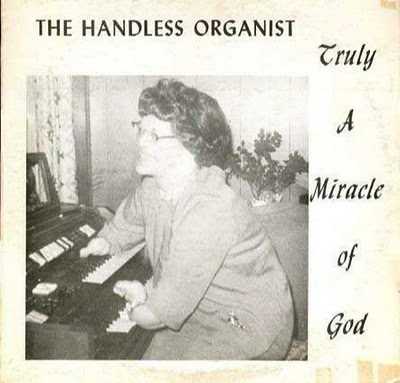
"Truly a Phenomenon of God!" (Source)

Another offering from "Piddling Richard Miller," this time with encompass art that closely if unintentionally replicates the ex voto model. The full anthology is online for your listening pleasure. (Source)
These musical works differ from the mainstream of Protestant aural culture in that, even when the songs themselves are classic hymns or are simply covers of more obscure songs by disabled artists, they take on a new, personal, and highly-charged meaning in the context of public disability. The artists are not just performing music, they are performing both disability and Christianity – indeed, they perform their disability precisely equally the cadre of their Christianity, and their Christianity every bit intimately bound up with their disability. The singer born without arms or the blind crooner or the organist missing her hands tin can all reach a new status every bit an icon of model Christian disability. Their operation points towards the hope of a transfiguration that surpasses inability in the kingdom of heaven. Moreover, their concrete or mental incapacity is often an implicit analogy for the spiritual deformation, blindness, or weakness found in the more conventional Gospel ballad. The healing of both comes from Jesus.
Mary Douglas, among other anthropologists, has noted that the body physical is often used as an analogy of the trunk politic. The symbolic representation of the individual corpus speaks to the social body at large – culturally-coded anxieties about the limits of the physical body frequently bespeak to an underlying feet about threats to the community. Should it surprise u.s. that the most visible flowering of this disability-obsessed genre came at a fourth dimension when the culture wars were starting to animate the full force of Southern and Midwestern Protestantism into a politically active bloc with an agenda for cultural change? Surely that socio-political context stands behinds Gary Bradford's "ameliorate state." The Evangelical doom song, with possibly its best representatives in the Louvin Brothers, rose to prominence at much the same time.
The fundamentalist folk spirituality that these songs nowadays are a major cultural context in the wonderfully agonizing, deeply Catholic work of Flannery O'Connor. In her curt story "A Temple of the Holy Ghost," she injects it into her description of a Southern freak show. A hermaphrodite addresses two crowds – i made upwardly of men, another of women – before displaying its unusual genitalia. The freak says,
"I'k going to show you this and if y'all express joy, God may strike you the same style." The freak had a country voice, deadening and nasal and neither high nor low, just flat. "God made me thisaway and if you lot laugh He may strike you the aforementioned way. This is the mode He wanted me to be and I ain't disputing His mode. I'k showing you because I got to brand the best of information technology. I expect you to act like ladies and gentlemen. I never done it to myself nor had a thing to exercise with it but I'g making the best of it. I don't dispute hitting." And so there was a long silence on the other side of the tent and finally the freak left the men and came over onto the women'due south side and said the same thing. (The Nerveless Stories of Flannery O'Connor 245).
Later, the hermaphrodite leads a kind of religious service centered on its own feel of God'southward Providence.
She could hear the freak saying, "God fabricated me thisaway and I don't dispute hit," and the people saying, "Amen. Amen."
"God done this to me and I praise Him."
"Amen. Amen."
"He could strike you thisaway."
"Amen. Amen."
"Only he has not."
"Amen."
"Heighten yourself upward. A temple of the Holy Ghost. Yous! You are God's temple, don't y'all know? Don't you know? God'due south Spirit has a dwelling in yous, don't you know?"
"Amen. Amen."
"If everyone desecrates the temple of God, God will bring him to ruin and if you laugh, He may strike you lot thisaway. A temple of God is a holy thing. Amen. Amen."
"I am a temple of the Holy Ghost."
"Amen."
The people began to slap their easily without making a loud noise and with a regular beat between the Amens, more and more softly, every bit if they knew there was a child nigh, half comatose. (Ibid., 246)
O'Connor, who suffered from lupus herself, draws a parallel betwixt the freak'southward preaching and Benediction of the Blessed Sacrament. In the two episodes, we can perceive both the sovereignty of God's Providence and the sacramental capacity of matter to comport God.
It strikes me as intuitively sensible that O'Connor should have chosen precisely this story to contrast Protestant and Catholic music. Early on on in the story, 2 immature Church of God men effort to woo a pair of Catholic sisters by singing a Gospel hymn, complete with guitar and harmonica. The girls, who take been educated at convent school, bite back their giggles and respond with the Tantum Ergo. I of their suitors is more right than he knows when, puzzled and slightly disapproving, he calls it "Jew singing." The two forms of music, though standing in an apparent contradiction, together anticipate the underlying sacramental truth presented past both the Protestant and Catholic services that conclude the story.
O'Connor makes much of Protestant devotional culture in one of her novels, The Violent Deport It Away (1955). Information technology is the story of a boy called to prophesy, of his skeptical schoolteacher cousin, and of the battle they wage for the soul of a mentally disabled child. At ane point, we come to the functioning of a family of traveling musical missionaries. The loftier signal of the act comes when their little daughter emerges from behind the curtain to preach a rousing sermon. In the form of her preaching, she delivers what may be the book'southward central bulletin:
"I've seen the Lord in a tree of fire! The Word of God is a burning Word to burn yous clean!…Burns the whole world, man and kid…none tin can escape…Are you deaf to the Lord's Word? The Word of God is a called-for Word to burn you clean, burns man and kid, man and child the same, you lot people! Be saved in the Lord's fire or perish in your ain! Be saved in…" (The Violent Bear It Away 134-35).
O'Connor is addicted of granting the near clear-eyed spiritual vision to the children in her stories. Many take profound experiences of grace that marker them forever, or they comport testimony of the invisible globe's unsafe immediacy to more than skeptical characters.

This album makes me think of O'Connor's 1955 The Vehement Acquit Information technology Abroad. (Source)
That includes O'Connor's disabled children. "The Lame Shall Enter Get-go," one of O'Connor'south nearly emotionally crushing short stories, is a close companion to The Violent Carry It Away. It tells the story of a well-meaning social worker, Sheppard, who takes in a clubfooted juvenile delinquent, Rufus Johnson, hoping to steer him towards a productive life. Although he can overlook Rufus's abiding spite, Sheppard is exasperated by the fundamentalist beliefs he clings to. Rufus is convinced he is going to hell, and starts to talk nigh it with the social worker and his impressionable young son. He steadily grows into the role of preacher even every bit Sheppard tries desperately to "affluent that out of [his] head." I won't get into any spoilers, equally the story has a wrenching, unforeseen climax. I'll just say that Sheppard finally realizes he has failed only when Rufus cries at him,
"I prevarication and I steal because I'g good at it! My human foot don't have a thing to practice with it! The lame shall enter first! The halt'll exist gathered together. when I get ready to be saved, Jesus'll save me, not that lying, stinking atheist, not that…" (The Collected Stories of Flannery O'Connor 480).
Sheppard attributes all of Rufus's bad beliefs to the emotional effect of his clubfoot. Only Rufus finds his one hope of conservancy in the fact that he has a inability that, according to the logic of heaven, volition ensure that he enters the Kingdom commencement. For Rufus, as for so many of the artists mentioned higher up, it represents both religion and hope (if not yet charity). Sheppard is too blinded past his prejudice and his loneliness to see that. The results are baleful.
Rufus'south underlying insight speaks to a truth often forgotten in the Church's handling of the disabled. Those with disabilities are non "issues." Information technology's true that they may take some special needs with regards to access, attention, etc. Simply at the end of the day, they are people who accept the same basic spiritual needs as whatever other human beings. They, too, tin embody and epitome Christ – frequently improve than those of u.s.a. who are blessed enough to be of both sound mind and body.
Gary Bradford himself has spoken publicly nigh this issue earlier. Some time in the late 1980's or early 1990'southward, Bradford – past then an adult – gave an interview with a Christian television network. He says,
In the past…so many of our churches, so many of our people in our church in the past, it's been the place for the practiced, the well-bodied, and the abled…And the Church isn't to exist like that; the Church is to accept all.
Of class, the other great danger is to place too much emphasis on the disability and not plenty on the person who has it. The "magical disabled person" should not become a trope in Christian life. We can't load our disabled brethren in Christ with that moral freight. Information technology isn't off-white. The disability Gospel genre fosters precisely that kind of harmful thinking; perchance that is its greatest cultural fault.
I think we can avoid either extreme – neglect or overemphasis – by focusing instead on the individuality and personhood of every disabled Christian. Insofar as the disability Gospel song is an ex voto, information technology may seem to stand for to a certain type. Cosmic ex votos normally practice. Only that'south only to the outsider who beholds the ex voto. For the i who makes it (or commissions information technology), the story it tells carries intense and highly particular personal meaning. Put another way; Sheppard may not grasp the subconscious meaning of Rufus's lodge foot, but Rufus does.
The aforementioned goes for the Protestant ex votos nosotros find in this genre. They may seem to correspond to the demands of a cottage industry, but they all epitomize and present private experiences. That particularity is the best affair we can accept from this foreign, lost genre of Christian music. There are no generic souls, abled or otherwise.
12. "Somebody That I Used to Know" merely Vaporwave.
xi. "Sumer is Icumen In," from The Wicker Man (1973).
x. "Demons," by Alex and "Slumber Games," past Pye Corner Audio.
nine. Tchaikovsky's Swan Lake theme.
8. Psalm 129 from King'south College Choir, Cambridge.
7. The soundtrack from Le Roi Danse.
6. "Never Enough" from The Greatest Showman.
5. "Pur Ti Miro," by Monteverdi.
4. The Little Match Girl Passion, past David Lang
3. The Farinelli soundtrack.
2. Michael Nyman'due south "The Garden is Becoming a Robe Room," "Prospero's Magic," and "Chasing Sheep is Best Left to Shepherds."
one. Various Arias from Handel, especially Rinaldo's "Il Vostro Maggio" and "Lascia Ch'io Piangia" also as nigh of "Ode for the Birthday of Queen Anne."

A Mozarabic illumination (Source)
In his Chapter Commentary on the Rule of St. Benedict yesterday, the Prior of Silverstream referred to a Mozarabic Pater Noster, "a chant of hit beauty." Information technology is marked by a repetition of responsory Amens throughout, an ancient liturgical practice that Dom Mark explains in his post. Naturally, I was curious, and soon establish a recording here. I thought my readers might enjoy it as much as I did. It is indeed full of a "striking beauty."

St. Philip, pray for us (Source)
As my readers will well know, St. Philip Neri is my favorite saint and has been for a long while now. I have every opportunity I tin can to sing his praises on this blog, and today happens to be 1 of them. In Oxford, nosotros are celebrating the Feast of the Patronage of St. Philip, a local solemnity that honors the canonical erection of the house hither as a Congregation of the Oratory. Please pray for the Oxford Fathers on this, their argent jubilee.
To celebrate, here is my favorite hymn to the Apostle of Rome – Pangamus Nerio, as sung past the choir of the Birmingham Oratory. It is the vesperal hymn of St. Philip.
Pangamus Nerio, debita cantica
Quem, supra nitidi sydera verticis,
Virtus et meritum sustulit inclytum,
Carpturum pia gaudia.
Noctes sub spectabus, corpora martyrum,
Quas implent, vigilat sedulus integras,
Ex ipsis satagens discere mortuis
Normam qua bene viveret.
Nocte dum Nereus fercula pauperi,
Gestans praecipitat, panniger Angelus
Tecto significat, qualiter excidat
Numquam fervida caritas.
Orantis penetrans cordis in intimum,
Laxavit spatium Spiritus impete
De Coelo veniens, esset ut hospiti
Immenso locus amplior!
Coelorum Domino, dum sacra munera
Libabat Nerius, saepius advolans,
Tellurem rapido corpore deserit,
Christo fiat ut obvius!
Corpus deseruit, cum Deus Hostiae
Fertur sub niveae tegmine conditus,
Prudens, in Patriam, pergere splendide
Nolens absque Viatico.
Amen.
Unfortunately, I don't have an English translation (nor the time and energy to interpret from the original myself). Alas.
May St. Philip Neri pray for Oxford, for the Oratorians there, and for all of us who call upon him in filial affection.

A cope depicting the Skillful Shepherd. (Source)
I realize that technically last week was Skilful Shepherd Sun in the traditional calendar, but as most of the Catholic world (alas) celebrates information technology tomorrow, I thought I'd offering up this truly dismal hymn from Fr. Faber. I have never nonetheless heard it set up to music, so if any of my readers happen to know of a recording, I would appreciate them kindly sharing it. Fr. Faber is one of my favorite spiritual writers and hymnodists…even when he's outlandishly bad.
The True Shepherd
Fr. Frederick William Faber
I was wandering and weary
When my Saviour came unto me;
For the ways of sin grew dreary
And the world had ceased to woo me:
And I thought I heard Him say,
As He came along His way,
O silly souls! come up near Me;
My sheep should never fear Me;
I am the Shepherd truthful.
At kickoff I would not hearken,
And put off till the morrow;
But life began to darken,
And I was sick with sorrow;
And I thought I heard Him say,
As He came forth His way,
O giddy souls! come nearly Me;
My sheep should never fear Me;
I am the Shepherd true.
At last I stopped to listen,
His vocalism could not deceive me;
I saw His kind eyes glisten,
So anxious to relieve me:
And I thought I heard Him say,
As He came along His way,
O giddy souls! come near Me;
My sheep should never fright Me;
I am the Shepherd truthful.
He took me on His shoulder,
And tenderly He kissed me;
He bade my dear be bolder,
And said how He had missed me;
And I'thou certain I heard Him say,
As He went forth His way,
O silly souls! come nigh Me;
My sheep should never fear Me;
I am the Shepherd true.
Strange gladness seemed to move Him,
Whenever I did better;
And he coaxed me so to love Him,
As if He was my debtor;
And I always heard Him say,
As He went along His mode,
O empty-headed souls! come up most Me;
My sheep should never fear Me;
I am the Shepherd true.
I thought His love would weaken,
As more and more He knew me;
But it burneth like a beacon;
And its light and heat get through me;
And I ever hear Him say,
As He goes along His way,
O silly souls! come near Me;
My sheep should never fear Me;
I am the Shepherd true.
Let united states do then, love brothers!
What volition best and longest please u.s.a.,
Follow not the means of others,
Only trust ourselves to Jesus;
We shall e'er hear Him say,
As He goes forth His way,
O silly souls! come virtually Me;
My sheep should never fright Me;
I am the Shepherd true.

"And then the black snake coursed the meadow,/The blood-red dragon rose unwombed,/While the tempest wailed like a shadow/To eternal ache doomed." – Johannes Carsten Hauch (Source)
As the world seems to be reeling towards another horrendous conflict, I am reminded of one of the greatest, nigh Dionysian pieces of recent anti-war art, Veljo Tormis's Raua Needmine (Expletive Upon Iron). Bleak as the Baltic, majestic as the dark woods of the north, and terrifying as Ragnarok itself, the 1972 piece from Republic of estonia managed to capture the frenzied devastation of state of war. It is music best listened to with eyes firmly shut.

The Wilmington Behemothic, Eric Ravilious (Source)
Recently I read an article almost a genre of music that had previously been unknown to me: Hauntology. In a nutshell, Hauntology is a throwback to the eerie, folksy world of British childhood in the 1970'due south. The writer summarizes the genre's affective bear on as "foreign, melancholy disquiet." Plain music is beingness made today (and has been for some time) that conjures all at one time that decade's public broadcasting for children, the acoustic sounds of the English folk tradition, psychedelia, pagan chants, and synthesizers. Most of this material has been released through a few different labels: Ghost Box, Clay Pipe, and Trunk Records. Each specializes in a different variation of the general theme. On the whole, though, they all produce music that'due south unsettling and evocative of a very particular identify and time in the last century. In that location is something autumnal, something anachronistic, something cleaved in it all. In brusk, it's music that'southward haunted.
Many of the albums have comprehend fine art inspired by Eric Ravilious or John Nash or Sir Stanley Spencer or even Male monarch Whistler, those painters who then marvelously captured the tranquillity unease of the British landscape and its citizenry. And the multimedia satirical phenomenon that is Scarfolk fits right into the broader movement. Hauntology is more than just a fashion of music. It's an aesthetic.
In this respect, Hauntology is to the 1970'south what Vaporwave is to the late 1980'southward and ninety'south, or, for that matter, what David Lynch's entire corpus is to the 1950's.

Malls built in the early years of Bush-league I are the stuff of Vaporwave dreams. (Source)
Vaporwave derives its critical bite equally well equally its occasional blusterous ephemerality from a unifying sense of dread. Much the same could be said of Hauntology. Just instead of the zombie-like ascent of neoliberal belatedly capitalism nether the glittering haze of digital culture and advertizing, Hauntology is still preoccupied with the anxieties of the analog age. Orwellian dystopia, the loss of the British countryside, and the destruction of innocence all hover under the surface. It'southward drawing upon creepy public service announcements rather than Japanese soft drink commercials. Hauntology is to British Folk Horror as Vaporwave is to Cyberpunk.

A scene from Blueish Velvet (1986), 1 of David Lynch'due south almost distinctive films. Information technology fix the tone for much of what was to follow in its powerful evocation and ultimately ruthless subversion of mid-century norms (Source).
The common denominator is nostalgia, but a nostalgia gratis of illusions. Each of these artful representations of a remembered decade – Lynch's 1950's, Hauntology's 1970's, and Vaporwave'due south Digital Age – contains a degree of attachment to that particular time. Usually because the principal creators involved in producing the aesthetic grew upward then, and thus they draw upon the dreamlike brume which alternately gilds and clouds our globe in youth. Merely it'south all shot through with the very real understanding that the past was not equally wonderful as nosotros would like to believe. Something nasty lurks just beyond our peripheral vision. We cannot aid remember, just in that remembrance, terror awaits.
I'm an American, and only in my early on twenties. 1970's Britain wasn't a world I always knew. Nevertheless, I immediately continued with the emotional phenomenon backside Hauntology. Certain relics of that earlier time appeared every now and then in childhood, and fifty-fifty those that weren't directly from the United kingdom of great britain and northern ireland of the 1970's frequently bring to mind that same feeling of remembered unease. Many of Don Bluth's films animate precisely this foreign, sensitive office of my memory. So do Stephen Gammell'southward original illustrations of the Scary Stories to Tell in the Night books. So does The October Country, Ray Bradbury's wonderful brusk story collection (which itself significantly predates the main era of Hauntology). So does anything past Lynd Ward. So do parts of Pink Floyd'southward The Wall. And then does that horrible movie, The Plague Dogs. There are probably more than examples I could summon upward if I thought about information technology long enough. I am no stranger to "strange, melancholy disquiet."
I've always liked that awareness, and I've e'er been drawn to other peoples' nostalgia. As such, I'thousand super pleased to take discovered Hauntology.
rodriguezastat1988.blogspot.com
Source: https://amishcatholic.com/tag/music/
0 Response to "Its Me Again Lord Blind Slye Twins"
Post a Comment